
In 2026, talking about AI in customer service is no longer a trend; instead, it’s an operational decision. However, many teams still mix two ideas that sound similar but behave very differently: the traditional chatbot and AI agents. That’s why before you invest in “automation,” it’s worth understanding what each approach delivers, when it makes sense, and which metrics actually move when implementation is done with care.
Besides, in most projects, the biggest risk isn’t the technology itself. In fact, the problem is usually expectations. Many businesses buy a bot expecting it to “sell on its own”; meanwhile, the team keeps answering the same questions, with the same messy handoffs, and the customer feels friction. By contrast, when automation is designed as part of a workflow, results become visible: shorter waits, better-qualified leads, and a more consistent brand experience. In summary, AI isn’t magic; it’s structure applied to conversations.
What a traditional chatbot is and why it still works
A traditional chatbot usually runs on rules: menus, buttons, keywords, and prebuilt flows. Therefore, it’s excellent when questions repeat and the user path is predictable, such as opening hours, pricing ranges, requirements, location, order status, or routing to a human. Besides, this type of bot is highly predictable, which makes it easier to control tone, compliance, and the exact wording of sensitive replies.
However, the limit shows up when the customer leaves the script. Instead of interpreting nuanced intent, a rules-based bot tends to fail when the conversation requires context, trade-offs, or information spread across different sources. In fact, the classic “I didn’t understand” is often a sign that the system missed the real intent. As a result, the customer gets frustrated, asks for an agent, and automation becomes just one more obstacle.
On the other hand, when designed well, the traditional chatbot can be a solid foundation for organizing first contact. Besides, it helps with triage and first-level support, filtering the obvious and saving human time for decisions that truly need judgment. In summary, it remains a strong tool when the goal is stability, consistency, and tight control.
What AI agents are and why they changed the game
AI agents take a different path. Instead of relying only on fixed rules, they interpret intent, context, and natural language. That’s why they can handle more flexible conversations, answer with variation, and respond better to questions that don’t follow a neat pattern. Besides, an AI agent can “think” with an objective: qualify a lead, guide a purchase, solve a problem, or route the request to the right team without forcing rigid menus.
However, flexibility brings new risks. By contrast, if you don’t define boundaries, permissions, and reliable knowledge sources, the agent can improvise, make errors, or deliver inconsistent information. In fact, many projects fail here: the business delegates without governance and, as a result, loses predictability and trust. When that happens, the channel becomes a risk for both sales and support.
That’s why the AI agents that win in 2026 aren’t the ones that “sound smart.” Instead, they are the ones that work with real data, safety constraints, and clear limits. In summary, a strong agent doesn’t replace the process; it executes the process with discipline.
The real difference: rules vs intent, and control vs flexibility
The honest comparison is simple. The traditional chatbot prioritizes control: you define each step, each response, and each route. By contrast, an AI agent prioritizes flexibility: it interprets the message and responds based on context. Therefore, the traditional chatbot is ideal when language must be exact, such as policies, warranties, payments, refunds, and other sensitive guidance. Meanwhile, the agent shines when the customer arrives with varied questions and needs orientation, not a menu.
Besides, the “hidden cost” changes. A rules-based bot demands effort in flow design and ongoing maintenance; however, it tends to remain stable once tuned. By contrast, an AI agent demands a governance layer: behavior configuration, knowledge management, monitoring, and quality evaluation. So, the work doesn’t disappear; it evolves. In fact, the most mature strategy is often hybrid: rules for what must be precise, and agents for what must be conversational.
What works in practice: metrics that don’t lie
To know whether AI is working, it’s not enough to “look intelligent.” That’s why certain metrics separate professional implementation from a simple demo. One is first response time: when it drops, customers feel speed and stay engaged longer. Besides, track containment rate, which shows how many conversations are resolved without a human stepping in.
However, containment can’t grow at the expense of quality. Instead, it must rise while satisfaction stays steady and answers remain clear. On the other hand, another decisive metric is lead qualification rate: how many leads reach your team already with useful data, such as service requested, city, urgency, and budget range. As a result, the sales rep stops wasting time on basic questions and starts closer to a decision point.
Meanwhile, watch WhatsApp conversion rate if that’s your core channel. If the same team closes more deals with less repetition, the improvement is real. In summary, success shows up when humans answer fewer repetitive questions and spend more energy on closing, resolving, and retaining customers.
When to choose a traditional chatbot and when to choose an AI agent
A traditional chatbot is the right choice when you need maximum consistency, short answers, and predictable routes. Therefore, it performs well for FAQs, department routing, simple data collection, and basic scheduling. Besides, it’s a good fit when you want to protect brand tone and reduce the risk of ambiguous replies.
By contrast, an AI agent makes more sense when the process has many variations and customers arrive with different types of questions. That’s why professional services, education, healthcare, real estate, technology, and agencies often benefit more from agents. In fact, the agent can identify intent and guide the customer without forcing menus, as long as the knowledge base is organized and kept current.
However, if the business lacks clarity on offers, terms, timelines, and policies, the agent will struggle. That’s why the first step is often to build a concise “business playbook” the agent can rely on. On the other hand, as volume grows, a hybrid model tends to be the most efficient: one layer filters and routes, another layer converses and qualifies, and humans step in to close or handle complex edge cases. In summary, hybrid gives balance between efficiency and safety.
A winning 2026 architecture: agent + inbox + CRM + automations
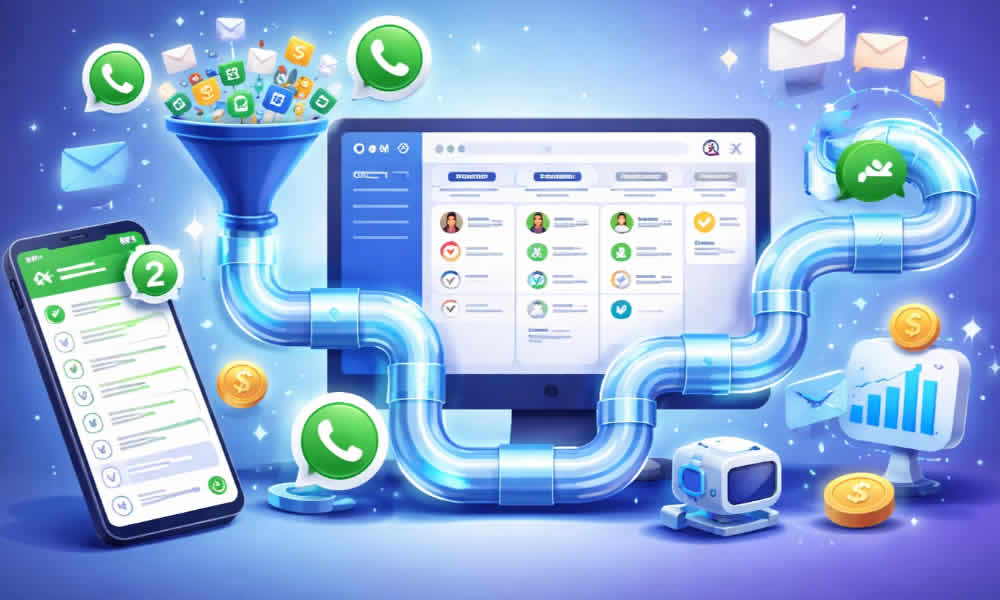
AI in customer service shouldn’t live in isolation. That’s why performance rises when you connect the system to a shared inbox with queues, a CRM, and workflow automations. Besides, with routing and assignment, the channel stops depending on “who saw it first” and becomes a process with ownership and traceability.
In fact, when an AI agent qualifies a lead, the best outcome is not just a nice conversation. Instead, the agent should register key data and trigger the next actions: create or update a CRM record, generate a brief for sales, schedule a follow-up, and notify a human when needed. Meanwhile, the team sees full context through tags and internal notes, so nobody starts from zero again. As a result, marketing, sales, and support stop stepping on each other and start operating with continuity. In summary, AI adds value when it reduces friction and accelerates decisions.
Common mistakes that make AI “not work” and how to avoid them
The most common mistake is asking AI to do everything. However, even advanced agents need clear limits: what they can promise, which data they can use, and when they must escalate to a human. Therefore, it’s essential to define transfer rules for sensitive cases, such as payments, critical complaints, cancellations, legal topics, or delicate personal contexts. As a result, you protect the customer and the operation.
Another mistake is running without a reference library. By contrast, an AI agent needs a strong base: services, pricing logic, terms, delivery timelines, policies, and consistent answers to recurring questions. Besides, when something changes, that base must be updated quickly. In fact, an outdated system can create more problems than it solves. That’s why governance is not an optional add-on; it’s part of the project.
On the other hand, it’s also a mistake to skip measurement and conversation review. Therefore, teams should audit transcripts, refine agent behavior, improve routing, and align the human team to collaborate with automation. In summary, AI improves through iteration, and the business wins through consistency.
The final shift that changes everything: AI that works with your team and your brand
In 2026, the difference isn’t simply “having AI.” That’s why the real advantage is AI that respects your process, your tone, and your limits. A traditional chatbot remains excellent for repetitive and high-risk tasks; meanwhile, an AI agent adds flexibility to converse, guide, and qualify. However, the outcome becomes truly strong when both are integrated with queues, CRM, and automations, and when your team has visibility and control over what’s happening.
As a result, WhatsApp stops being a reactive channel and becomes a scalable system for sales and support. In summary, if you want performance that lasts, choose a strategy built on clarity, safety, and a customer experience that feels consistent from the first “hi” to the final decision—exactly the kind of structure Agencia Evolution builds when the goal is growth with control.